After the Crash: Which Crypto and Blockchain Projects Actually Survived — and Why They're Worth Watching
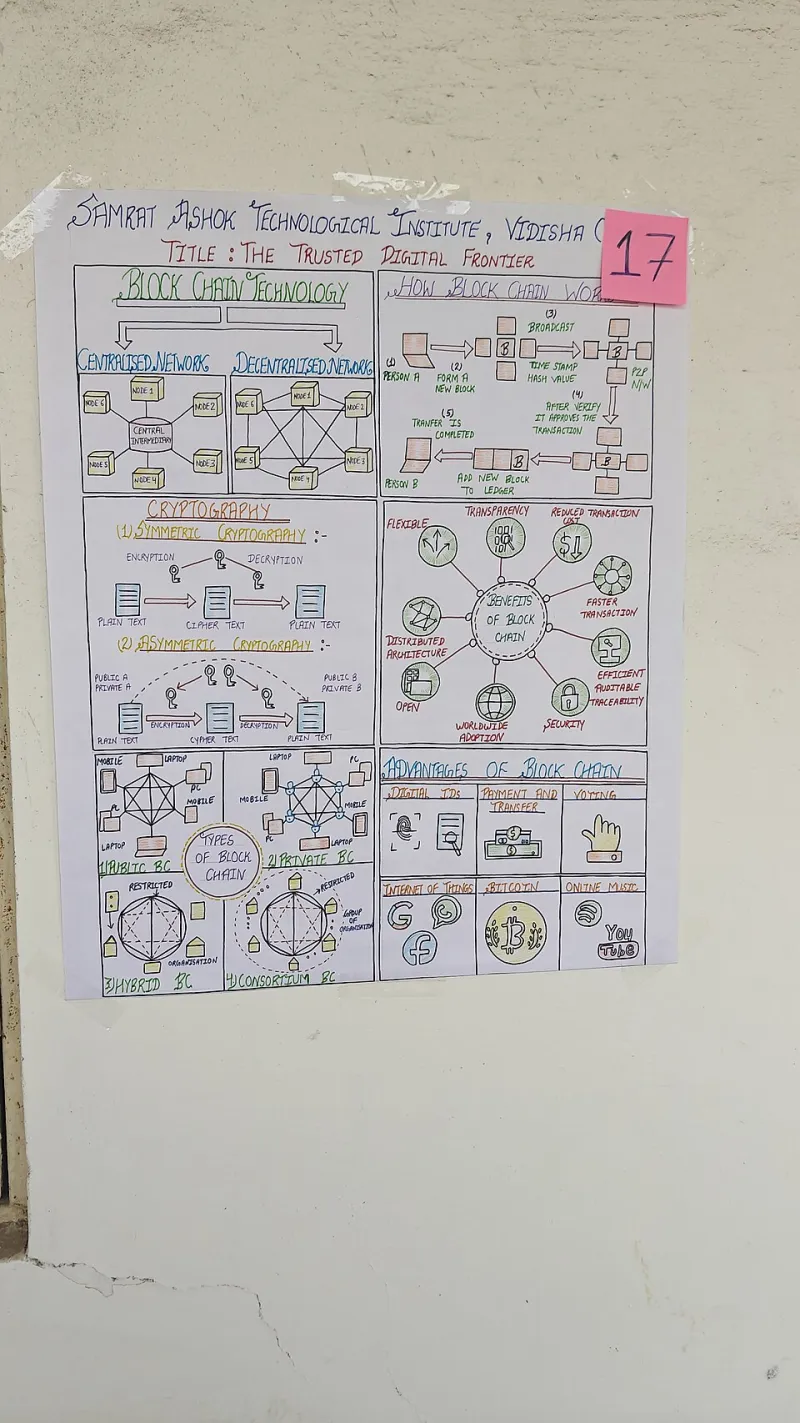
Photo: Anushka10patel, CC BY-SA 4.0, via Wikimedia Commons
Remember 2021? Every startup deck had a blockchain angle. Your barbershop was talking about NFTs. A JPEG of a cartoon ape sold for $3.4 million, and somehow that felt normal for about six months. Then interest rates went up, leverage unwound, Sam Bankman-Fried turned out to be running a fraud, and the whole ecosystem lost roughly $2 trillion in market value.
It was ugly. It was also, arguably, necessary.
Because here's the thing about speculative bubbles: they're terrible for investors and great for separating genuinely useful technology from narratives propped up by cheap money. The dot-com crash wiped out Pets.com and left behind Amazon. The crypto crash wiped out Terra Luna, Celsius, and a thousand vaporware tokens — and left behind some infrastructure that's actually worth understanding.
So let's take an honest look at what's still standing, what it does, and whether any of it matters to people who aren't already deep in the ecosystem.
What the Wreckage Actually Looked Like
Before getting to the survivors, it's worth being direct about what the crash exposed. A significant portion of the 2020–2022 crypto economy was built on circular logic: tokens that derived value from people believing other people would buy them. DeFi protocols offering 20% annual yields on stablecoins weren't generating returns from real economic activity — they were paying early participants with the capital of later ones. That's not innovation. That's a structure with a name.
NFTs, in their dominant form, turned out to be speculative certificates of bragging rights. The "ownership" they conferred was largely social rather than legal or functional. When social momentum reversed, the floor on most collections collapsed to near zero. OpenSea, once valued at $13 billion, laid off most of its staff and is a fraction of its peak valuation.
And the centralized crypto exchanges — Celsius, Voyager, FTX — demonstrated that putting "crypto" in your branding doesn't make you immune to the oldest failure mode in finance: using customer deposits to fund risky proprietary bets.
None of that is controversial anymore. The question is what's on the other side of it.
The Infrastructure That Kept Building
Ethereum's transition to proof-of-stake was genuinely significant and got underreported outside crypto circles. The Merge in September 2022 cut Ethereum's energy consumption by roughly 99.95%, which removed one of the most legitimate criticisms of the network. Ethereum isn't a speculative token play — it's a programmable settlement layer that processes billions of dollars in transactions daily. That doesn't mean ETH is a good investment at any given price. But the network itself is real infrastructure.
Layer 2 scaling solutions like Arbitrum, Optimism, and Base (Coinbase's L2) have quietly made Ethereum-based transactions fast and cheap enough to actually use. A transaction that cost $50 in gas fees at peak congestion in 2021 now costs cents on Arbitrum. This matters because high fees were the single biggest practical barrier to blockchain applications working for normal-sized transactions.
Stablecoins have found a genuine use case — just not the one the hype cycle promoted. Cross-border payments and remittances using USDC or USDT are cheaper and faster than traditional wire transfers for many corridors, particularly in Latin America and Southeast Asia. Circle, the company behind USDC, has been actively pursuing regulatory clarity and banking partnerships in the US. This is boring, unsexy infrastructure work. It's also real.
DeFi: Separating the Useful from the Wreckage
Decentralized finance took the hardest reputational hit of any crypto subsector. That's partly fair and partly a case of the worst actors defining the category.
The protocols that survived — Uniswap, Aave, MakerDAO (now Sky) — share a few characteristics: they're non-custodial (they never hold your funds), they're governed by transparent smart contracts, and they've been battle-tested under adversarial conditions. Uniswap processes billions in trading volume monthly without a central operator. That's not nothing.
What DeFi hasn't solved is the oracle problem — the challenge of connecting on-chain logic to real-world data without introducing a trusted intermediary. Chainlink has made progress here, and it's one of the more quietly important infrastructure projects in the space. But until this is more robustly solved, DeFi's utility for anything involving real-world assets remains constrained.
The 20%-yield DeFi farms are largely gone. What's left is leaner and, honestly, more interesting.
Enterprise Blockchain: Finally Getting Honest
For years, enterprise blockchain was a punchline — IBM and Maersk spent years on a shipping consortium blockchain that was ultimately abandoned. Walmart's food traceability blockchain generated press releases and questionable ROI. The honest assessment is that most enterprise blockchain projects between 2017 and 2022 were either proof-of-concept theater or used a distributed database where a regular database would have worked fine.
The more recent wave is more grounded. JPMorgan's Onyx platform processes institutional repo transactions on a private blockchain, and the bank is transparent that it's using the technology because of specific settlement-time advantages, not because blockchain is inherently magical. SWIFT has been piloting cross-border payment integrations with Chainlink's cross-chain interoperability protocol.
The shift is from "blockchain because blockchain" to "blockchain for this specific settlement or provenance problem where the trustless verification matters." That's a much smaller set of use cases than the 2018 hype suggested — but they're real ones.
Startups Worth Actually Watching
A few names that are building in this space without the vaporware energy:
Alchemy — Developer infrastructure for blockchain applications. They're the AWS of Web3 in a meaningful sense: they don't bet on any single chain winning, they make it easier for developers to build on all of them. They've been quietly profitable and stayed out of the speculation narrative.
Polygon (now rebranding around its AggLayer tech) — Ethereum scaling infrastructure with real enterprise traction. Nike, Starbucks, and Reddit all ran Web3 projects on Polygon. The consumer experiments were mixed, but the infrastructure held up.
Stripe's stablecoin payments product — Stripe reintegrated crypto payments in 2024, specifically for USDC on Solana and Ethereum. When Stripe moves, it's because there's merchant demand. Watch this one.
Did We Learn Anything?
Honestly? Some of us did. The retail investors who lost savings on Terra Luna or trusted centralized platforms with their assets learned a brutal lesson about the gap between decentralization rhetoric and custodial reality. Regulators learned that crypto moves faster than their frameworks and are now playing catch-up with a mix of enforcement and (slowly) clearer rules.
The builders who kept their heads down during the hype cycle and kept shipping are now operating in a less crowded, more credibility-conscious environment. The tourists left. The infrastructure got more solid. The use cases got more specific.
Blockchain isn't going to replace the dollar or eliminate banks or tokenize everything. But programmable settlement layers, stablecoin payment rails, and transparent on-chain financial protocols are real tools solving real problems for specific markets.
That's less exciting than a cartoon ape worth a million dollars. It's also considerably more likely to still exist in five years.