Core Counts, Clock Speeds, and Confusion: How Chipmakers Broke the Way We Shop for CPUs
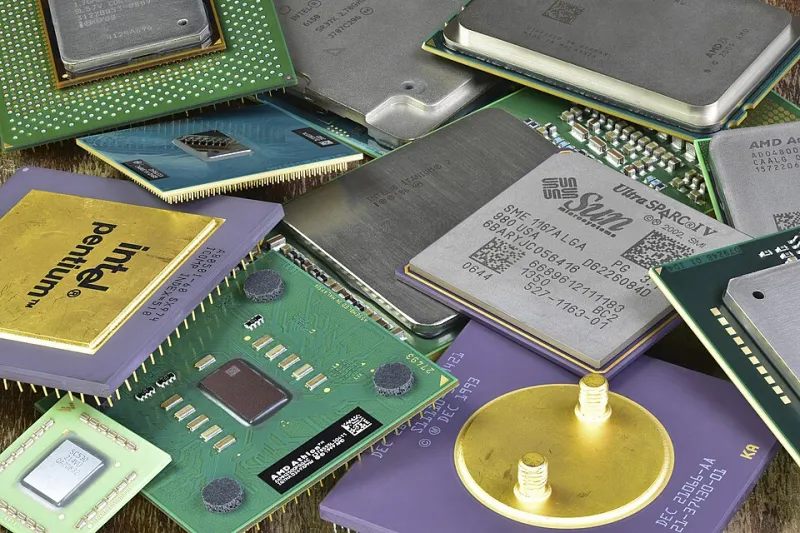
Photo: Martijn Boer, Public domain, via Wikimedia Commons
Not that long ago, picking a processor was almost intuitive. Higher clock speed meant faster chip. More cores meant better multitasking. The numbers told a story you could actually follow. That era is gone — and it didn't disappear by accident.
Today's CPU market is a labyrinth of product tiers, power envelopes, and performance claims that seem engineered to make direct comparisons as painful as possible. Intel and AMD have both played a role in this, and the result is a shopping experience that leaves even technically savvy buyers second-guessing themselves at checkout.
The Core Count Inflation Problem
At some point, chipmakers figured out that bigger numbers sell. So they started shipping more of them — even when those cores weren't created equal.
Intel's hybrid architecture, which mixes Performance cores (P-cores) with Efficiency cores (E-cores), is the most visible example of this. A chip advertised as "24-core" sounds formidable. But a meaningful chunk of those cores are E-cores optimized for background tasks and power savings, not raw throughput. That's not necessarily bad engineering — it actually works well for certain workloads — but marketing those chips with a flat core count is deliberately misleading when consumers are conditioned to treat cores as a simple performance proxy.
AMD has pulled its own version of this with chiplet-based designs. Ryzen processors built across multiple dies can show uneven memory latency depending on which cores are handling a task. Again, the underlying tech is genuinely impressive. But the headline spec sheet doesn't come close to capturing these nuances.
The result? You can have two chips with identical core counts that perform completely differently depending on what you're running — gaming, video editing, software compilation, or just keeping 40 browser tabs open while you pretend to be productive.
TDP: The Number That Means Almost Nothing Anymore
Thermal Design Power used to be a reliable baseline. It told you roughly how much heat a chip would generate under load, which helped you plan cooling solutions and estimate power draw. Now it's mostly decorative.
Intel rebranded its power spec into a tiered system — Base Power, Maximum Turbo Power — that allows chips to operate far above their rated TDP for sustained periods. A processor listed at 125W TDP might happily pull 250W when it decides the workload demands it. AMD's situation isn't much cleaner, with TDP figures that often reflect best-case scenarios rather than real-world sustained performance.
This matters for everyday consumers in a very concrete way: the cooling solution that should theoretically pair with your chip might be completely inadequate for how the chip actually behaves. You find this out the hard way — usually when your system throttles under load or your case sounds like a jet engine.
There's also the power bill to consider. American households are already dealing with rising electricity costs. A chip that routinely blows past its rated TDP isn't just a thermal problem — it's a budget problem that nobody mentions in the product listing.
The Consumer vs. Enterprise Segmentation Game
Here's where the deliberate obfuscation gets really cynical. The same physical silicon often underlies both consumer and enterprise chips — but chipmakers artificially restrict features on the consumer side to protect higher-margin product lines.
ECC memory support is the classic example. Error-correcting memory is legitimately useful for anyone running demanding workloads, creative professionals included. It's not some exotic enterprise-only technology. Yet it's routinely locked out of consumer processors to keep those users from bypassing the workstation or server product tiers that carry much fatter price tags.
PCIe lane counts follow the same logic. Enthusiast-class chips get more lanes; mainstream chips get fewer — not because of any architectural necessity, but because the segmentation supports a pricing ladder. Consumers pay for the artificial ceiling as much as for the chip itself.
AMD has been marginally better about this with some of its Ryzen Pro lines offering ECC support, but the broader industry pattern holds. The segmentation isn't about matching hardware to genuine use-case differences. It's about extracting maximum revenue from every corner of the market.
What You Should Actually Look At
Given all of this, what metrics can you actually trust when you're shopping for a processor?
Real-world benchmark results for your specific workload. Generic benchmark suites like Cinebench give you a starting point, but they don't tell you how a chip handles your use case. If you edit video, look at export benchmarks. If you game, look at 1% low frame times, not just averages. Sites like UserBenchmark have their own biases, so cross-reference against multiple sources.
Sustained performance, not peak performance. Many chips look incredible in short-burst benchmarks and mediocre in extended workloads once thermal limits kick in. Look for reviews that test sustained multi-threaded performance over longer periods.
Platform longevity. AMD has historically been better about socket compatibility across generations. Intel has a habit of retiring platforms faster. If you're building a system you plan to upgrade incrementally, this matters more than a few percentage points of raw performance.
Actual power consumption under load. Not the TDP spec — actual measured wattage from reviewers who use a wall meter. This tells you what your cooling needs to handle and what your electricity usage will look like.
Price-to-performance in the mid-range. The flagship chips from both Intel and AMD are increasingly priced for enthusiasts with money to burn. The mid-range — think Ryzen 5 and Core i5 territory — often delivers 80-90% of top-tier performance at half the price. The law of diminishing returns hits hard at the top of the stack.
The Bigger Picture
The CPU market's growing opacity isn't an accident or a side effect of genuine technological complexity. It's a strategy. When consumers can't make clean apples-to-apples comparisons, they're more likely to default to brand loyalty, fall for headline numbers, or simply spend more than they need to because the safer-feeling option is the more expensive one.
Chipmakers aren't doing anything technically illegal here. But there's a real cost — in consumer dollars, in upgrade anxiety, and in the sheer cognitive overhead of trying to make an informed purchase in a market that's been deliberately muddied.
The best defense is treating spec sheets as marketing materials first and technical documents second. Because that's increasingly what they are.